MING Introduces the 57.05 Comet, a New Worldtimer with a Mechanical DST Adjustment
Marking nine years of MING, the 57.05 Comet introduces a patent-pending bezel system that mechanically adjusts world time for daylight saving time, alongside a dynamic multilayered blue dial.
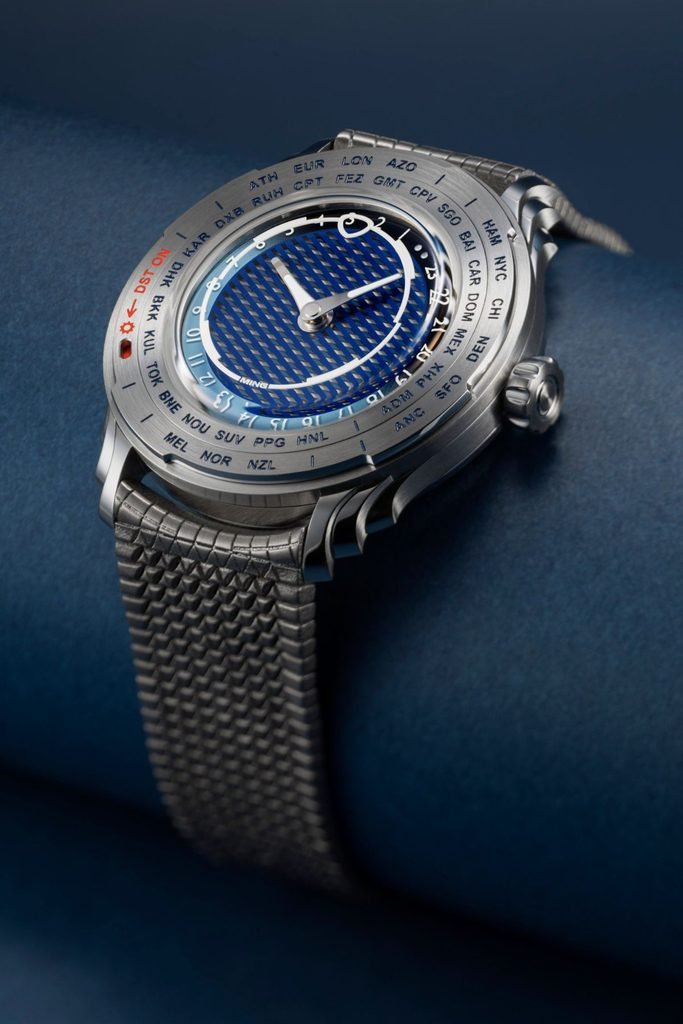
MING celebrates its ninth anniversary with the introduction of the 57.05 Comet, a new worldtimer designed around the realities of modern international travel. The watch combines MING’s distinctive fifth-generation design language with a patent-pending mechanical system that allows daylight saving time to be adjusted with a single click of the bezel.
Limited to just 200 pieces, the MING 57.05 Comet brings together a 40 mm stainless-steel case, a dynamic multilayered blue dial, a Sellita for MING 330.M2 automatic calibre and 100 metres of water resistance. It is also the brand’s most accessible worldtimer to date, with prices starting at CHF 6,950.
The name Comet references the de Havilland Comet, the world’s first commercial jet airliner, connecting the watch to the beginning of the jet age and the transformation of international travel. At the same time, the concept recalls the history of the worldtimer itself and the work of Geneva-based watchmaker Louis Cottier, whose worldtime system became one of the defining approaches to displaying multiple time zones on a wristwatch.

The MING 57.05 Comet and a New Approach to World Time
Worldtimer watches are designed to make international travel easier, allowing the wearer to read multiple time zones simultaneously. But conventional worldtime displays are built around standard time, meaning that daylight saving time can introduce an additional complication that remains for the wearer to calculate manually.
The MING 57.05 Comet approaches this problem differently. Instead of asking the wearer to make a mental adjustment, MING has developed a mechanical system that allows the cities affected by daylight saving time to be shifted by one hour directly through the bezel.
The system is deliberately simple to operate. Cities that do not observe daylight saving time remain fixed on the inner bezel, while cities that do observe it are positioned on a separate outer bezel. Rotating this outer bezel by a single click — exactly 15 degrees — advances only the relevant cities by one hour against the 24-hour scale.
The result is a worldtimer designed around an aspect of international travel that traditional worldtime watches generally leave to the wearer.

A Mechanical Solution to Daylight Saving Time
The defining feature of the MING 57.05 Comet is its patent-pending daylight saving time adjustment system. The outer bezel locks into either its standard-time or daylight-saving-time position using a spring-loaded ball and corresponding recesses beneath the bezel.
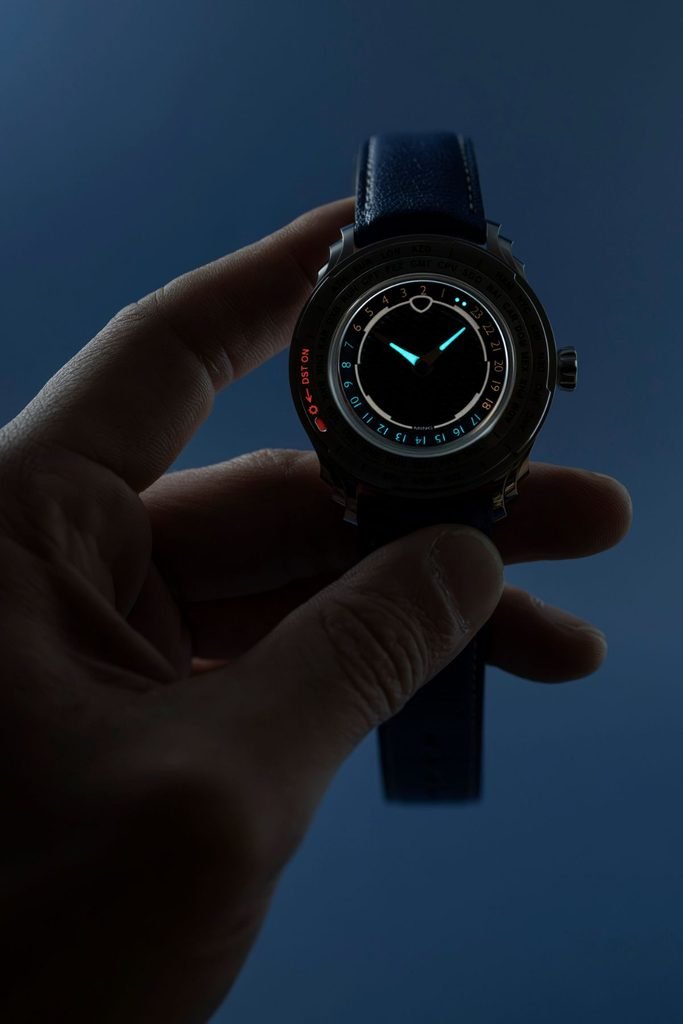
A small aperture marked “DST ON”, positioned between eight and nine o’clock, provides a visual indication of the selected setting. In standard time, the indicator appears silver, while the daylight-saving position is shown in red.
MING has also incorporated dedicated grip points into the edge of the outer bezel, making the adjustment easier to operate while reinforcing the deliberate tactile character of the mechanism.
The entire system is designed to perform one specific task: adjust the cities that observe daylight saving time without moving those that do not. It is an unusually practical interpretation of the worldtimer complication and one that reflects MING’s broader approach to familiar watchmaking mechanisms.
The Comet Tail Dial
The worldtime mechanism is not the only part of the 57.05 Comet that changes depending on time and light. At the centre of the watch is a multilayered blue dial featuring overlapping raster structures that create what MING calls the “Comet Tail”.
A raster is essentially a repeating grid of lines or openings. When two such grids overlap, even small changes in their alignment can create significantly larger visual patterns. MING uses this optical principle to create a dial whose appearance gradually changes as the relationship between its layers shifts.
Rather than presenting a completely static surface, the Comet Tail dial appears to flow and evolve throughout the day. The result is a watch face that can reveal something different from one glance to the next, depending on the angle and lighting conditions.
This approach is particularly representative of MING’s design philosophy, which frequently explores the relationship between light, colour and form rather than relying solely on conventional decorative finishing.

A Worldtimer That Changes Character at Night
The dial takes on another identity once the ambient light disappears. The hands use blue-emission Super-LumiNova X1, while the 24-hour scale uses different colours to distinguish between daytime and nighttime hours.
The daytime portion emits blue light, while the nighttime hours glow orange, making the worldtime display easier to interpret in low-light conditions.
When daylight saving time is active, the DST ON indicator in the bezel also emits red light, providing an immediate visual confirmation that the mechanical adjustment is engaged.
Above the dial, the floating box-style sapphire crystal is laser engraved and filled with MING’s proprietary Polar White luminous material. This creates white-emission markers for the primary 12-hour indices and adds another luminous layer to the watch’s architecture.
MING’s Fifth-Generation Design Language
The 57.05 Comet belongs to MING’s fifth-generation design language, immediately recognisable through its distinctive triple-stepped lug architecture.
The stainless-steel case measures 40 mm in diameter and just 10.33 mm in thickness, giving the watch relatively compact proportions for a worldtimer with this level of functionality. The case is machined from 316L stainless steel and combines Art Deco references with the more sculptural forms associated with MING’s current design language.
The lugs are particularly complex. MING uses no fewer than nine individual components in their construction, allowing neighbouring surfaces to receive sharply differentiated brushed and polished finishes. This approach would be considerably more difficult to achieve using conventional single-piece case construction.
Despite this complexity, the 57.05 Comet remains designed as a practical travel watch rather than a purely architectural exercise. Its case provides 100 metres of water resistance, while the 20 mm lug width allows it to be paired with different strap options.
Sellita for MING Calibre 330.M2
Inside the 57.05 Comet is the self-winding Sellita for MING 330.M2 calibre, visible through the sapphire exhibition caseback.
The movement offers approximately 50 hours of power reserve and operates at 4 Hz, or 28,800 vibrations per hour. It measures 26.2 mm in diameter and 4.10 mm in thickness and features 25 jewels.
MING has given the movement a visual treatment consistent with the rest of the watch. Its bridges are skeletonised and finished with brushing and an anthracite coating, positioned over a matching anthracite-coated baseplate.
The movement therefore complements the dark mechanical character of the caseback while maintaining the contemporary aesthetic for which MING has become known.

Two Strap Options
The 57.05 Comet is available with two different strap configurations. The first pairs the watch with a cobalt blue goatskin leather strap produced by Jean Rousseau Paris. The second option uses MING’s Polymesh titanium bracelet-strap hybrid.
The Jean Rousseau strap features curved quick-release spring bars and a flying-blade tuck buckle with micro-adjustment, adding a practical element to the otherwise highly technical design.
The choice of cobalt blue leather also reinforces the colour palette established by the multilayered Comet Tail dial.

A Worldtimer Designed for Modern Travel
The MING 57.05 Comet is ultimately less about reproducing the traditional worldtimer and more about reconsidering how the complication should work in everyday life.
The addition of a mechanical daylight saving time adjustment may appear like a relatively small detail, but it addresses a genuine limitation of conventional worldtime displays. Rather than forcing the wearer to remember which cities have moved forward by an hour seasonally, the watch allows the relevant locations to be adjusted directly through the bezel.
That functionality is combined with a dial that is intentionally dynamic, a case architecture built from multiple components and a modern automatic movement visible from the reverse.
The result is a worldtimer that remains unmistakably MING while offering a complication that is genuinely useful to travellers who regularly move between time zones.
Limited to 200 Pieces
The MING 57.05 Comet will be produced as a limited edition of just 200 pieces. Orders open on 27 August 2026 at 1:00 PM GMT through the official MING website and the brand’s international authorised retail network.
The watch will be available at CHF 6,950 with the leather strap or CHF 7,950 with MING Polymesh, with prices excluding taxes.
The 57.05 Comet will also be presented publicly during Geneva Watch Days, where MING will exhibit from 2 to 5 September 2026.
For a brand celebrating its ninth anniversary, the 57.05 Comet brings together several of the ideas that have defined MING’s development: unconventional case construction, displays that interact with light, practical functionality and a willingness to rethink established complications.
Its patent-pending DST mechanism is perhaps the clearest expression of that philosophy. The worldtimer is a familiar complication, but MING has identified a modern problem within it and created a mechanical solution that is both simple to understand and satisfying to operate.
Combined with the evolving Comet Tail dial and distinctive 40 mm case, the result is one of the more unconventional interpretations of the worldtimer complication — and a fitting watch to mark nine years of MING.
Technical Specifications
| Model | MING 57.05 Comet |
| Function | Hours, minutes, world time |
| Worldtime adjustment | Patent-pending mechanical DST adjustment bezel |
| Case material | 316L stainless steel |
| Case diameter | 40 mm |
| Case thickness | 10.33 mm |
| Lug-to-lug | 47.8 mm |
| Lug width | 20 mm |
| Water resistance | 100 metres |
| Crystal | Box sapphire crystal, front and rear |
| Crystal treatment | Double-sided anti-reflective coating |
| Dial | Multilayered blue “Comet Tail” |
| Worldtime indication | Rotating 24-hour ring |
| Daytime lume | Blue-emission Super-LumiNova X1 |
| Nighttime lume | Orange-emission Super-LumiNova X1 |
| Hands | Blue-emission Super-LumiNova X1 |
| DST indicator | Red-emission Super-LumiNova X1 |
| 12-hour markers | MING Polar White luminous material |
| Movement | Sellita for MING 330.M2 |
| Movement type | Automatic |
| Jewels | 25 |
| Frequency | 4 Hz / 28,800 vph |
| Movement diameter | 26.2 mm |
| Movement thickness | 4.10 mm |
| Power reserve | Approximately 50 hours |
| Movement finishing | Skeletonised, brushed and anthracite-coated bridges and baseplate |
| Strap option 1 | Cobalt blue goatskin leather by Jean Rousseau Paris |
| Strap option 2 | MING Polymesh titanium |
| Limited edition | 200 pieces |
| Price | CHF 6,950 on leather / CHF 7,950 on MING Polymesh |
| Warranty | 2-year limited mechanical warranty |
| Availability | 27 August 2026, 1:00 PM GMT |
| Presentation | Geneva Watch Days, 2–5 September 2026 |
For more information, please visit the official MING website.
Explore the releases of 2026.