Jaeger-LeCoultre Reverso Tribute Enamel ‘Turner Series’ Brings Venice to Life
Four exceptional Reverso timepieces bring J.M.W. Turner’s luminous visions of Venice to life through miniature painting, Grand Feu enamel, paillonnage and hand-guilloché.
Introducing the Jaeger-LeCoultre Reverso Tribute Enamel Turner Series, a collection of four limited-edition timepieces created in homage to Venice and the extraordinary way J.M.W. Turner captured its light, water and atmosphere.
Jaeger-LeCoultre has unveiled the Reverso Tribute Enamel ‘Turner Series’, a collection of four limited-edition timepieces created in homage to Venice and the extraordinary way J.M.W. Turner captured its light, water and atmosphere.
Coinciding with Jaeger-LeCoultre’s participation in the Homo Faber Biennale in Venice this September, the collection places miniature reproductions of four of Turner’s Venetian paintings on the reversible casebacks of the Reverso. Each watch combines miniature painting, Grand Feu enamelling, paillonnage and hand-guillochage, turning the iconic Reverso into a miniature canvas for artistic expression.
Only 10 pieces of each model will be produced, making the series a particularly exclusive celebration of both Turner’s artistic legacy and the craftsmanship cultivated within Jaeger-LeCoultre’s Métiers Rares™ atelier.

Turner And His Enduring Fascination With Venice
Joseph Mallord William Turner, born in London in 1775, is regarded as one of the most influential painters in Western art history. Although best known for his landscapes, Turner gradually moved away from the realism that characterised his early work, developing an increasingly expressive approach centred on colour, light and atmosphere.
His work explored a rapidly changing world shaped by industrialisation, social transformation and political and economic upheaval. Rather than simply reproducing what he saw, Turner used colour and light to evoke emotion, anticipating artistic developments that would later influence both Impressionism and Abstract Expressionism.
Venice became one of his most enduring subjects. Turner visited the city three times, in 1819, 1833 and 1840. Each journey took place in late summer, when the humidity created a soft haze over the canals and seemingly allowed Venice’s architecture to float above the lagoon.
His productivity during these visits was remarkable. Although he exhibited only 25 Venetian paintings during his lifetime, he produced around 150 watercolours and as many as 900 drawings during his three stays, with his oil paintings of Venice completed later in his London studio.
The four works selected by Jaeger-LeCoultre capture different aspects of Turner’s fascination with the city, placing particular emphasis on the changing relationship between light, water, architecture and atmosphere.

A Reverso Designed As A Canvas
The reversible construction of the Reverso has long provided Jaeger-LeCoultre with a natural surface for artistic decoration. With the case flipped, the blank metal reverse becomes a canvas, allowing miniature works of art to sit discreetly on the wrist.
For the Turner Series, this space has been used to reproduce four of the artist’s Venetian paintings at an extraordinary scale. The largest original work in the collection measures 68 by 91 centimetres, yet each composition has been reduced to approximately 2 cm² while preserving as much of its character and detail as possible.
The process requires around 80 hours of work for each watch. The original paintings also had to be carefully cropped to suit the portrait orientation of the Reverso case without losing the essence of each composition.
Recreating Turner’s characteristic treatment of light presented an additional challenge. His paintings are defined by subtle transitions between atmosphere, water and sky, with reflections appearing to shift as the viewer looks at the work.

Fourteen Layers Of Enamel
The miniature paintings on the casebacks combine Grand Feu enamelling with paillonnage to reproduce the luminous quality of Turner’s Venetian scenes.
To create the floating effect of the clouds, the enameller works across multiple planes. Clouds are painted, covered with translucent enamel and fired, then repainted before additional translucent layers are applied across the surface.
The process requires 14 layers of enamel in total: three base layers, four layers of painting and seven layers of translucent fondant. Each layer requires a separate firing at 800°C.
Paillonnage is used to enhance the appearance of the water. Silver leaf is placed over the base enamel before the image is painted with translucent coloured enamel, creating additional brilliance and texture within the lagoon and its reflections.
Each miniature also contains a discreet secret signature made from a gold-leaf paillon, identifying the enameller responsible for the work.

Hand-Guilloché Meets Grand Feu Enamel
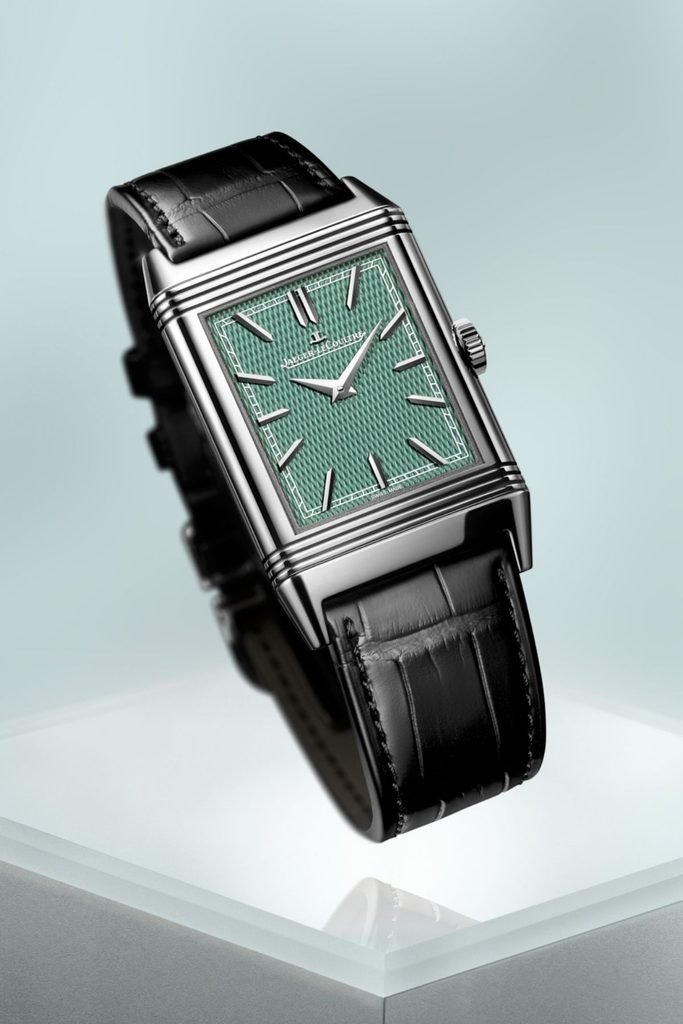
The artistic treatment continues on the front of each Reverso. The dials combine hand-guillochage with translucent Grand Feu enamel, with the pattern and colour of each dial chosen to complement the miniature Turner painting on the reverse.
The guilloché is executed using a manually operated rose engine lathe. Depending on the model, the process can require hundreds of precisely controlled operations.
The ‘Venice, the Dogana and San Giorgio Maggiore’ model features a soleil croisé pattern made from 180 finely engraved lines, each requiring six successive passages of the rose engine, resulting in 1,080 passages.
The ‘Venice, from the Porch of Madonna della Salute’ model uses a rice-grain pattern, while the ‘Bridge of Sighs, Ducal Palace & Custom House’ model features a barleycorn pattern. The fourth watch, dedicated to ‘Venice, the Bridge of Sighs’, uses a wide, deep wave pattern designed to evoke the reflections moving across Venice’s canals.
After the guillochage is completed, each dial requires a further eight to nine hours of enamelling, with up to five layers of enamel and as many as seven separate firings at 800°C.
The final stage is no less demanding. Faceted applied hour markers must be mounted by drilling tiny holes through the enamel without cracking its pristine surface, while the chemin de fer minute track is applied with precision.
Four Views Of La Serenissima
Each of the four watches interprets a different Turner painting and translates its atmosphere into both the caseback and the front dial.
Venice, The Dogana And San Giorgio Maggiore
Painted in 1834, this composition places light, colour and reflection at the centre of the scene. The white façade of San Giorgio Maggiore anchors the composition, while Venetian buildings gradually disappear into the hazy distance.

Silver paillons beneath the enamel enrich the representation of the lagoon and intensify the shifting reflections of the water. The green tones of the scene are echoed on the front dial through the soleil croisé guilloché pattern.

Venice, From The Porch Of Madonna Della Salute
Turner’s 1835 painting captures Venice through a hazy atmosphere in which architecture and reflections appear to merge. Silver paillons beneath the enamel recreate the subtle texture and luminosity of the water.

The green tones of the lagoon are continued on the dial, where a rice-grain guilloché pattern produces constantly changing effects of light and shade as the watch moves.
Bridge Of Sighs, Ducal Palace & Custom House
This work, completed in 1833, represents Turner’s first Venetian view painted in oils. It was also a direct tribute to the earlier Venetian artist Giovanni Antonio Canaletto.

The composition contrasts the green lagoon with the rosy tones of the Doge’s Palace and the bright blue sky. Silver paillons once again enhance the reflections in the water.
The front dial echoes the sky with translucent blue Grand Feu enamel applied over a basket-weave guilloché pattern.

Venice, The Bridge Of Sighs
Painted in 1840, this final work captures both the beauty and decline of Venice. Turner contrasts the darker foreground with glowing reflections across the buildings and lagoon.

The dial translates the blue sky into a subtle lavender-toned Grand Feu enamel, while a wavy hand-guilloché pattern evokes the rippling reflections of Venice’s canals.

The Calibre 822
All four watches are powered by Jaeger-LeCoultre’s manually wound Calibre 822, a movement developed specifically for the Reverso and used within the collection for more than two decades.
Measuring just under 3 mm in height, the movement is shaped to fit the Reverso’s rectangular case while maintaining the collection’s slender proportions.
Calibre 822 operates at 21,600 vibrations per hour, or 3 Hz, and offers a power reserve of 42 hours. Its simplicity allows the attention to remain firmly on the decorative arts that surround it, bringing together traditional watchmaking with guillochage, enamelling, paillonnage and miniature painting.
A Celebration Of Craftsmanship In Venice
The Reverso Tribute Enamel ‘Turner Series’ reflects a natural connection between Jaeger-LeCoultre’s approach to Métiers Rares™ and the philosophy behind the Homo Faber Biennale.
Created to celebrate excellence in craftsmanship, Homo Faber brings together master artisans, emerging talents and designers in Venice. Jaeger-LeCoultre’s participation provides an appropriate setting for a collection whose entire concept revolves around the meeting point between fine watchmaking and artistic craftsmanship.
The Turner Series also demonstrates how the Reverso has evolved far beyond its original purpose. Since its creation in 1931, the reversible case has remained one of the watch’s defining characteristics, but the blank reverse side has repeatedly been transformed into a canvas for engraving, enamel, gemstones and miniature art.
With the Turner Series, that canvas becomes a window onto Venice as seen through one of Western art’s most distinctive interpreters of light.
Each of the four Reverso Tribute Enamel ‘Turner Series’ watches will be limited to just 10 pieces, creating a total production of 40 timepieces across the collection.
Technical Specifications
| Collection | Reverso Tribute Enamel ‘Turner Series’ |
| Movement | Jaeger-LeCoultre Calibre 822 |
| Movement Type | Manual-winding |
| Functions | Hours and minutes |
| Power Reserve | 42 hours |
| Case Material | 18K white gold |
| Case Dimensions | 45.6 × 27.4 × 9.73 mm |
| Water Resistance | 3 bar |
| Dial | Hand-guilloché with Grand Feu enamel |
| Caseback | Miniature painting with Grand Feu enamel |
| Craft Techniques | Miniature painting, Grand Feu enamel, paillonnage and hand-guilloché |
| Craftsmanship Time | Approximately 80 hours per watch |
| Strap | Black alligator leather |
| Limited Edition | 10 pieces per model |
| Total Collection | 40 pieces |
| Models | Venice, the Dogana and San Giorgio Maggiore; Venice, from the Porch of Madonna della Salute; Bridge of Sighs, Ducal Palace |
| Price | On request |
For more information, please visit the official Jaeger-LeCoultre website.
Explore more releases of 2026.